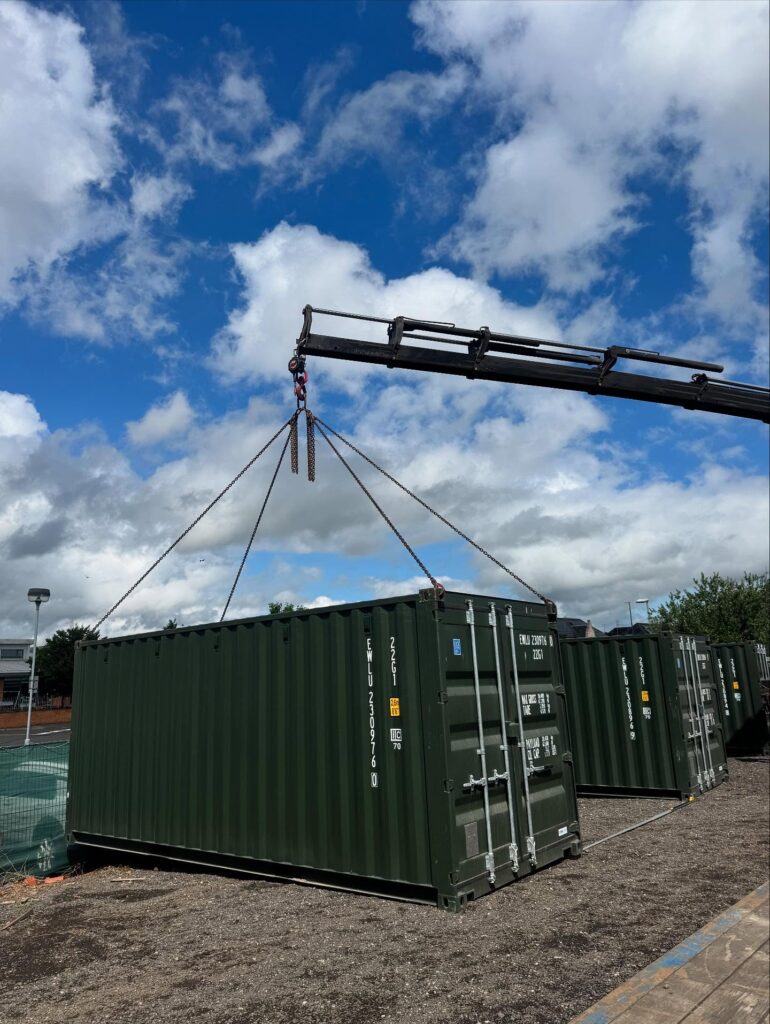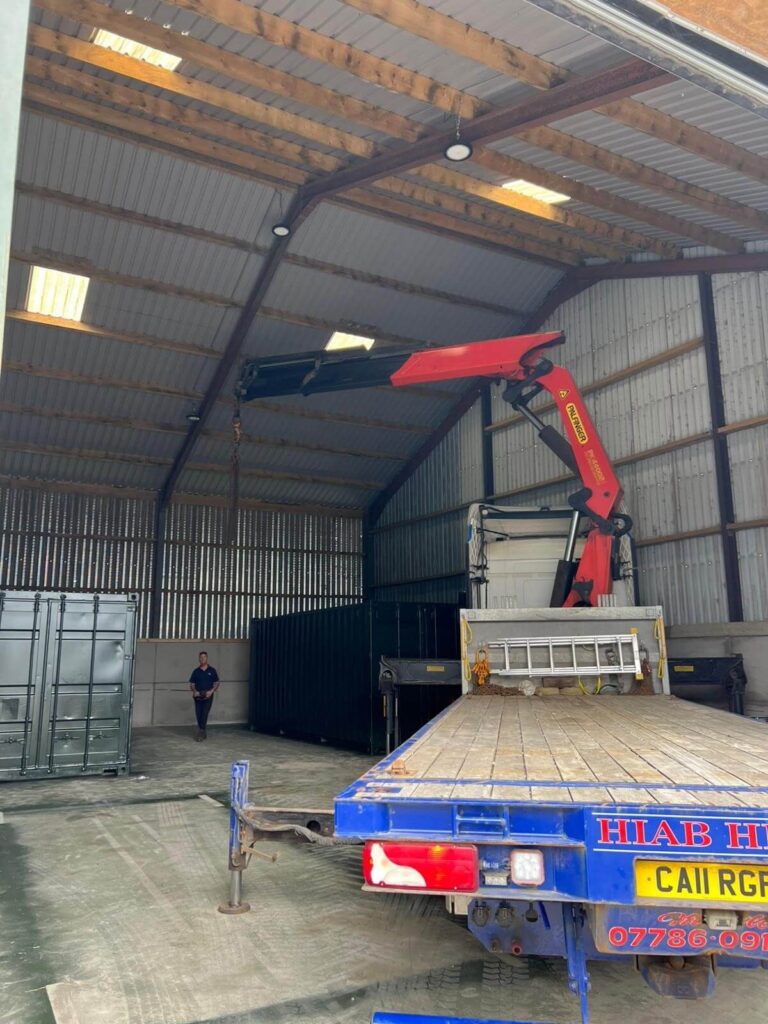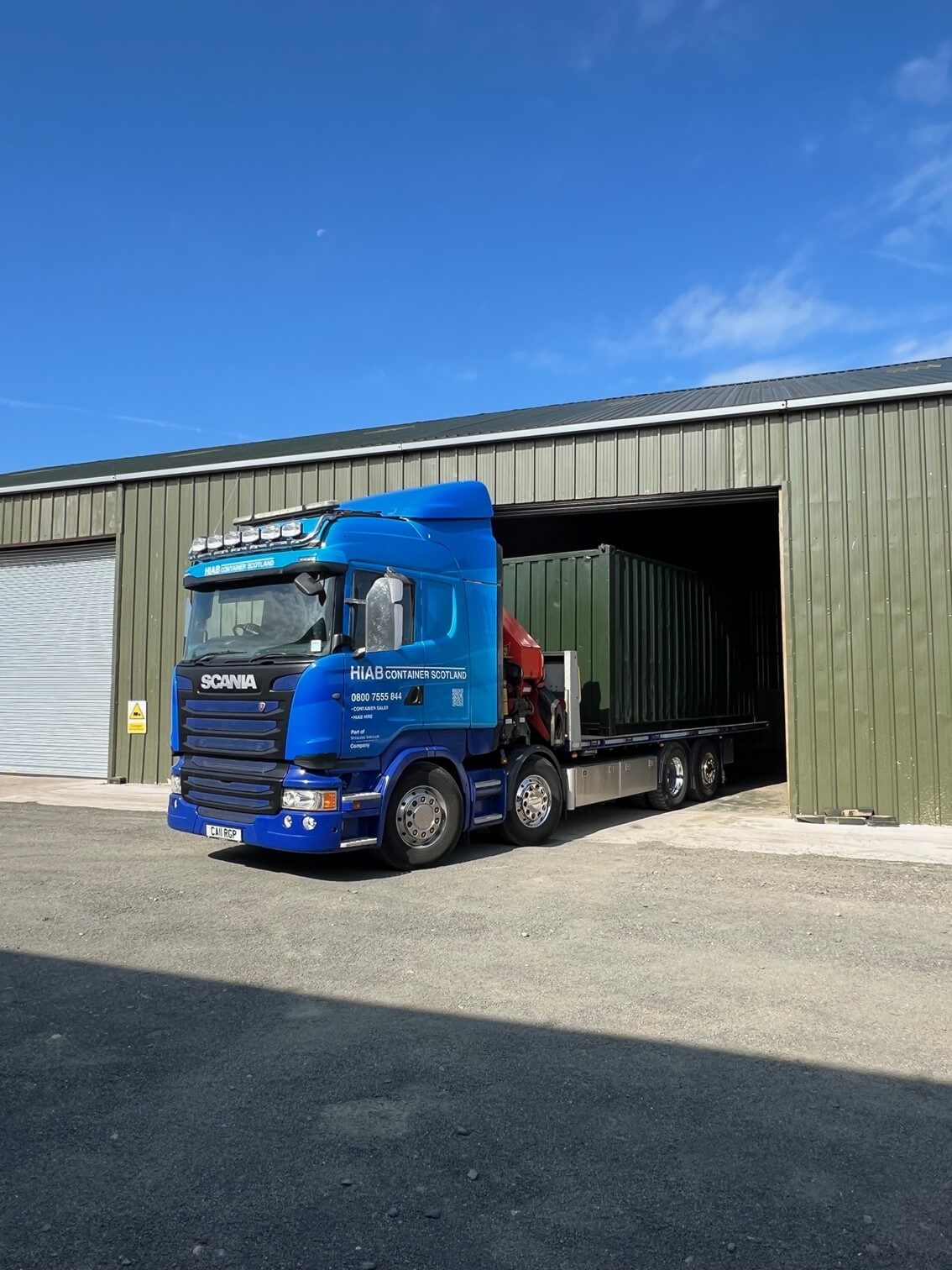
A standard delivery lorry can transport goods from one location to another, but it normally relies on equipment or workers at the destination to unload them. A HIAB lorry carries its own hydraulic crane, allowing the same vehicle to transport, lift and position heavy or oversized items.
That difference can completely change how a delivery is planned. Instead of arranging a lorry, a mobile crane and separate lifting personnel, a suitable HIAB can often complete the entire operation in one visit.
For shipping containers, portable buildings, machinery and other difficult loads, this combined service can reduce handling, simplify scheduling and make deliveries possible at sites without unloading equipment.
What Is a Standard Delivery Lorry?
A standard delivery lorry is designed primarily to transport goods. Depending on the vehicle, those goods may be carried on a flatbed, inside a curtain-sided body or within an enclosed box.
The lorry can take the load to its destination, but it may not be capable of unloading it independently. A forklift, telehandler, loading bay, gantry crane or separate mobile crane might be needed when it arrives.
For palletised products delivered to a warehouse, this is rarely a problem. Warehouses and distribution centres usually have forklifts, loading bays and staff ready to receive incoming goods.
Difficulties arise when the destination is a private property, construction site, farm, temporary worksite or undeveloped piece of land. These locations may have no suitable equipment for unloading a large or heavy item.
What Is a HIAB Lorry?
A HIAB is a lorry fitted with a hydraulic loader crane. The crane is mounted directly onto the vehicle, commonly behind the cab or at the rear of the load bed.
“HIAB” began as a manufacturer’s brand name, but the term is now widely used in the UK to describe lorry-mounted cranes from several manufacturers. The more technically accurate terms include loader crane, lorry loader and truck-mounted crane.
The crane folds away when the vehicle is travelling. Once the lorry reaches the site, stabiliser legs are deployed and the crane can load, unload or position the item.
Modern loader cranes can provide considerable lifting power and reach. However, their lifting capacity reduces as the distance between the crane and the load increases. The weight of the item and the required lifting radius must therefore be considered together.
The Main Difference Is the Built-In Crane
The most obvious difference is that a standard delivery lorry carries goods, while a HIAB lorry can carry and lift them.
A standard lorry might deliver a shipping container to a site, but something else must remove the container from the vehicle. A HIAB can arrive with the container, lift it from the load bed and place it in an agreed position.
This makes a HIAB particularly valuable when the load cannot be handled manually and no lifting equipment is available at the destination.
The crane may also be able to reach over walls, fences, hedges or other obstacles. Whether a particular lift is possible depends on the load weight, crane specification, operating radius, available space and site conditions.
Standard Delivery Lorry vs HIAB Lorry
| Feature | Standard delivery lorry | HIAB lorry |
|---|---|---|
| Primary purpose | Transporting goods | Transporting and lifting goods |
| Built-in crane | No | Yes |
| Self-loading capability | Usually no | Yes, within the crane’s capacity |
| Self-unloading capability | Usually no | Yes |
| Precise load placement | Limited | Possible when access and reach allow |
| External equipment | Often requires a forklift or crane | Frequently completes the lift independently |
| Suitable for heavy individual items | Transport only | Transport, unloading and positioning |
| Restricted-access lifting | Limited | Can reach over some obstacles |
| Site preparation | Receiving equipment may be needed | Space and suitable ground are required |
| Typical loads | Pallets, parcels and general freight | Containers, cabins, machinery and structural materials |
A HIAB Can Load Itself
A standard lorry normally needs assistance at the collection point. The sender may use a forklift, overhead crane or other equipment to place the goods on the vehicle.
A HIAB can often collect an item from a location without dedicated loading equipment. Its crane can lift the load onto the vehicle before it is secured for transport.
This is useful when collecting containers, machinery, cabins or other heavy objects from private land and smaller commercial sites. It can also reduce the number of contractors that must be coordinated at the collection point.
Self-loading is still subject to the crane’s capacity and the available access. The operator needs accurate information about the item’s weight, dimensions, lifting points and position before confirming that the collection is possible.
A HIAB Can Place a Load More Precisely
Unloading is not always as simple as removing an item from the lorry. The customer may need it placed on a prepared base, behind a wall or beside an existing building.
A standard lorry cannot normally provide that level of positioning. Even if the load is removed by forklift, the forklift must be able to reach the final location.
A HIAB crane can provide more controlled placement. The operator can raise, lower and move the load while observing its position, although the available precision depends on the load, lifting accessories and site conditions.
For a shipping container, this allows the unit to be positioned with its doors facing the required direction. Careful placement can also help the container sit level so that its doors operate correctly.
A HIAB Can Reach Beyond the Vehicle
A standard lorry usually has to be unloaded immediately beside the vehicle. The receiving forklift or crane then takes over.
A HIAB can lift a load away from the lorry and, with the correct equipment, may place it beyond an obstacle. This can be useful for reaching into gardens, compounds, construction sites and areas where another vehicle cannot travel.
The crane’s maximum advertised reach does not mean it can lift every load at that distance. As the boom extends, the weight it can safely handle decreases.
This is why a HIAB company needs more than the load’s weight. The operator also needs to know how far the item must travel from the crane and whether there are obstacles that affect the lifting path.
HIAB Deliveries Still Need Suitable Access
A HIAB is more flexible than a standard delivery lorry, but it cannot operate everywhere. It is still a large commercial vehicle that requires sufficient road width, turning room and clearance.
Space is also needed for the crane and stabiliser legs. The stabilisers create a wider operating base and help keep the vehicle stable while the crane is lifting.
Before the delivery, the site should be checked for:
- Narrow entrances or gateways
- Parked vehicles
- Low bridges or weight restrictions
- Overhead cables
- Trees and projecting branches
- Building canopies and roof edges
- Walls, fences and street furniture
- Sloping, soft or uneven ground
- Drain covers and underground services
- Space for the stabiliser legs
- Room for the crane to move safely
Photographs, measurements and an accurate description of the site can help determine whether the proposed position is practical. More complicated deliveries may require a site assessment.
Ground Conditions Matter More During a HIAB Delivery
A standard delivery lorry needs ground capable of supporting the vehicle. A HIAB needs ground capable of supporting the vehicle and the additional forces created during lifting.
The stabiliser legs transfer forces into relatively small areas. Suitable spreader pads may be used to distribute those forces, but they do not automatically make unsuitable ground safe.
Soft verges, recently disturbed ground, unsupported paving and unidentified underground services can create problems. Sloping ground can also affect the vehicle’s stability and the available crane capacity.
The final position for the load must be considered separately. For example, a shipping container normally needs a firm, level and appropriately prepared base.
The Load Requires More Detailed Planning
A standard pallet delivery is usually based on the number of pallets, their combined weight and the delivery address. A HIAB operation requires additional information.
The operator may need:
- The confirmed or estimated load weight
- The full length, width and height
- The centre of gravity
- Details of suitable lifting points
- The collection and delivery postcodes
- The distance from the vehicle to the placement point
- Photographs of both locations
- Information about overhead and ground-level obstacles
- Details of the proposed lifting accessories
- The condition of the receiving surface
- Any site rules, delivery restrictions or induction requirements
An apparently light item may require a larger crane if it must be positioned a long distance from the vehicle. An extremely heavy object may be manageable when kept close to the crane but impossible at a longer radius.
The Load Must Still Be Secured for Transport
The crane does not secure the load while the vehicle is travelling. Once an item has been loaded, it must be restrained using a suitable load-securing system.
Current DVSA guidance states that transported goods must be loaded, carried and unloaded safely. It also makes clear that a vehicle-mounted crane or its lifting accessories must not be used as a method of securing the load.
Chains, lashing straps, twist locks, chocks, cradles or other systems may be required, depending on what is being transported. The chosen attachment points must also be suitable for the expected forces.
The load should remain secure during normal driving and foreseeable emergency manoeuvres. HSE guidance similarly emphasises managing the risks created during loading, transport and unloading. Relevant information is available from the DVSA load-securing code and HSE load-security guidance.
HIAB Lifting Is Subject to Specific Safety Requirements
A standard delivery involves vehicle and load-safety responsibilities. A HIAB operation adds the risks associated with lifting equipment and suspended loads.
Vehicle-mounted cranes used at work fall within the scope of the Lifting Operations and Lifting Equipment Regulations 1998, commonly known as LOLER. The regulations require lifting operations to be planned properly by a competent person, supervised appropriately and carried out safely.
The lifting equipment must be suitable for the task, marked with its safe working load and subjected to the required examinations. Slings, chains and other lifting accessories must also be appropriate for the load.
The level of planning should reflect the complexity of the lift. A straightforward routine delivery may require relatively simple planning, while a heavy, long-reach or restricted-site operation may require a more detailed lifting plan. The HSE’s LOLER overview explains these duties in greater detail.
What Can a HIAB Deliver?
HIAB lorries are particularly useful for loads that combine difficult transport with difficult unloading.
Common examples include:
- Shipping containers
- Storage containers
- Portacabins
- Welfare units
- Modular buildings
- Heavy machinery
- Generators and compressors
- Construction plant
- Steel beams
- Timber frames
- Precast concrete
- Large glass panels
- Marble and granite
- Hot tubs and swim spas
- Garden buildings
- Sculptures and public art
- Advertising signs
- Renewable-energy equipment
- Electrical cabinets and switchgear
The right vehicle depends on the load rather than the general category. Two objects described as “machinery” may have completely different weights, dimensions, centres of gravity and lifting requirements.
When Is a Standard Delivery Lorry the Better Choice?
A HIAB is not necessary for every delivery. Standard haulage may be more economical when the goods are palletised and both locations have suitable unloading equipment.
A conventional lorry may be the better option when:
- The collection site has a forklift
- The destination has a loading bay
- The goods can be unloaded manually
- The receiving site has a suitable telehandler
- No crane-assisted placement is required
- The load is ordinary palletised freight
- The journey involves multiple standard distribution depots
There is little value in paying for specialist lifting capability when the site already has appropriate equipment and the load is straightforward.
When Is a HIAB the Better Choice?
HIAB hire becomes useful when transport and lifting must be coordinated as one operation.
It may be the better choice when:
- Neither location has unloading equipment
- The item is too heavy for manual handling
- The load must be positioned accurately
- A container or cabin needs relocating
- Access prevents a forklift from reaching the final position
- The load must pass over an obstacle
- Hiring a separate crane would complicate the project
- The collection involves a heavy object on private land
- The delivery site has no permanent lifting facilities
- Reducing the number of vehicles on site would make the work easier to manage
The key benefit is not simply that a HIAB has a crane. It is that the same vehicle can collect, carry, unload and position the item.
Does a HIAB Replace Every Type of Crane?
A HIAB does not replace every mobile or site crane. Its capabilities are limited by its rated lifting capacity, available reach, vehicle stability and operating environment.
Very heavy loads, extreme reaches and lifts requiring specialist configurations may need a larger mobile crane. Some sites may also be unsuitable for a HIAB because the vehicle cannot get close enough to the load.
The correct choice should be based on the full lifting requirement rather than convenience alone. Weight, radius, access, ground conditions and surrounding hazards all affect the decision.
Choosing the Right Delivery Method
A standard delivery lorry is designed to move goods efficiently between locations that can handle their own loading and unloading. A HIAB adds a lorry-mounted crane, turning the vehicle into a combined transport and lifting solution.
For straightforward pallets arriving at a prepared warehouse, a standard lorry may be all that is required. For a shipping container, portable cabin, machine or oversized item arriving at a site without lifting equipment, a HIAB may be considerably more practical.
Before requesting a quotation, gather the load dimensions, weight, collection address, delivery address and photographs of the proposed lifting areas. With that information, we can assess whether HIAB transport is suitable and identify the type of vehicle needed for the job.