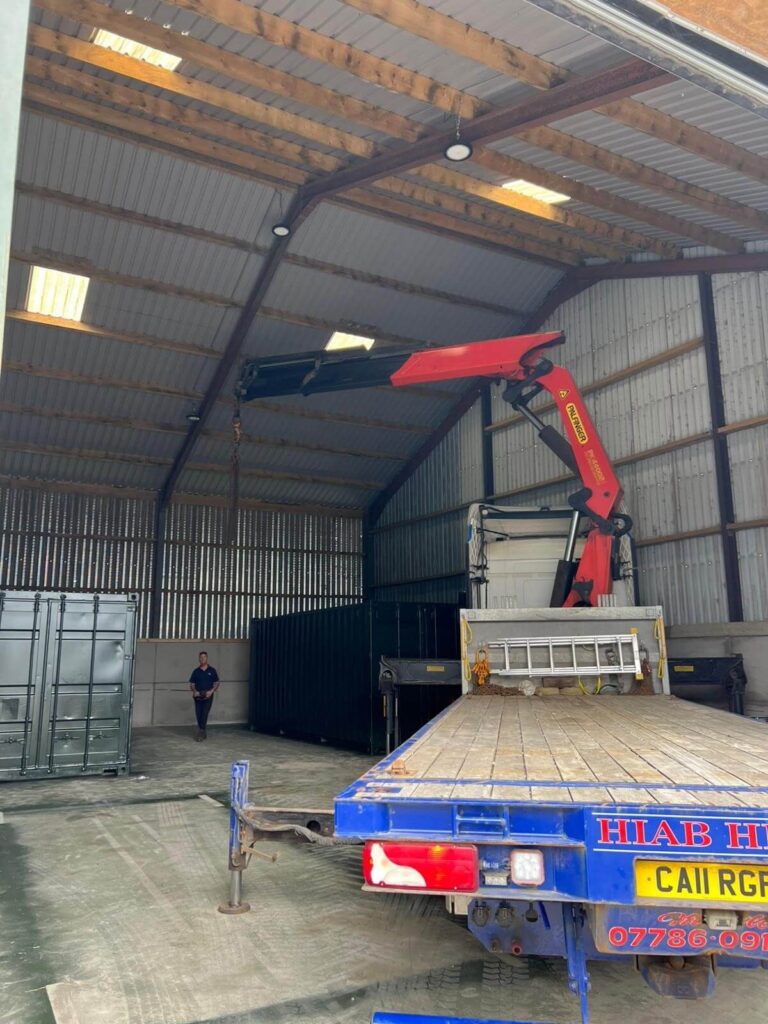
A wagon-and-drag HIAB is a rigid lorry fitted with a hydraulic loader crane that tows a separate drawbar trailer. Instead of relying on one load bed, the combination provides two separate carrying platforms while allowing the crane on the rigid truck to handle loads carried on both sections.
This type of vehicle is especially useful when a job requires more carrying space than a standard rigid HIAB can provide, but still benefits from the flexibility of an onboard crane.
A wagon-and-drag setup can carry long, heavy or mixed loads while remaining more adaptable than some larger articulated combinations. It is commonly associated with construction materials, structural steel, timber, precast products, machinery and other bulky loads that need both transport and crane-assisted loading or unloading.
For a broader look at what these vehicles can handle, see our guide to what HIAB trucks are used for.
How Is a Wagon-and-Drag HIAB Set Up?
The vehicle is made up of two connected sections rather than a single continuous platform.
At the front is a rigid heavy goods vehicle fitted with the HIAB crane and its own load bed. Behind it is a separate drawbar trailer, often with multiple axles and a flat load deck.
This gives the operator two distinct carrying areas while retaining the lifting ability of the crane fitted to the rigid truck.
The Rigid Wagon
The main vehicle is typically a heavy rigid lorry, and many wagon-and-drag combinations use an eight-wheel chassis.
The rigid section carries the crane, stabilisers and one of the load beds.
Because the crane is part of the main vehicle, the rigid wagon can continue operating independently if the trailer is uncoupled.
This is one of the features that gives wagon-and-drag configurations much of their flexibility.
The Drag Trailer
The second part of the combination is the drawbar trailer, commonly referred to as the “drag”.
It is connected to the rigid wagon through a drawbar coupling rather than a conventional articulated fifth-wheel arrangement.
The trailer provides another load platform for additional materials, equipment or longer cargo.
Depending on the individual vehicle configuration and load, the crane on the rigid truck may be used to load or unload both the wagon and trailer.
What Does the HIAB Crane Do?
The HIAB crane provides the lifting capability for the combination.
“HIAB” is originally a crane manufacturer name, but the term has become widely used to describe lorry-mounted hydraulic loader cranes more generally.
The crane is commonly installed behind the truck cab, although vehicle layouts vary.
Its job is to lift loads from the ground, position them on either load platform where the crane has sufficient reach and capacity, and unload them again at the destination.
That allows a wagon-and-drag vehicle to provide transport and lifting without automatically requiring a separate mobile crane or forklift at each end.
This is one of the main advantages of HIAB hire compared with conventional haulage.
Why Use Two Separate Load Beds?
The two-deck arrangement is one of the defining advantages of a wagon-and-drag setup.
Instead of trying to fit everything onto one long rigid platform, different loads can be divided between the truck and trailer.
This can make load planning considerably more flexible.
Separating Different Types of Cargo
The wagon and trailer can be used to keep different materials apart.
For example, a construction delivery might carry structural steel on one platform and palletised materials or equipment on the other.
This can make loading and unloading more organised, particularly where items are required in a particular sequence.
The exact arrangement still has to comply with vehicle weight, axle loading and load-securing requirements.
Carrying Long or Bulky Items
The extra platform provides considerably more carrying space than a single rigid HIAB.
Typical loads can include:
- Structural steel.
- Timber.
- Pipes.
- Precast concrete.
- Construction plant.
- Site equipment.
- Machinery.
- Fabricated components.
- Building materials.
- Palletised goods.
This can make wagon-and-drag vehicles useful where one delivery includes several large items or where different types of cargo need transporting together.
How Much Can a Wagon-and-Drag HIAB Carry?
The exact capacity depends on the individual vehicle.
Many heavy wagon-and-drag combinations operate within the UK maximum gross combination weight applicable to suitable vehicle configurations, which can be up to 44 tonnes.
That figure includes the weight of the rigid truck, crane, trailer, fuel, equipment and payload. It should not be confused with the amount of cargo the vehicle can actually carry.
A particular wagon-and-drag HIAB may have a usable payload in the region of 14 tonnes, but this varies substantially between vehicles.
The actual payload depends on factors including:
- Crane size and weight.
- Rigid chassis weight.
- Trailer weight.
- Number of axles.
- Body construction.
- Stabiliser equipment.
- Fuel and accessories.
- Individual axle limits.
- How the cargo is distributed.
For that reason, payload should always be checked against the specification of the actual vehicle being used rather than treated as a universal figure.
What Is the Advantage of a Detachable Trailer?
One of the most useful characteristics of a wagon-and-drag vehicle is that the trailer can be separated from the rigid truck.
This creates operating options that are not available with a permanently connected single-body vehicle.
The rigid wagon can potentially continue working independently while the trailer remains at another suitable location.
Leaving the Trailer on Site
Where site conditions and operational arrangements allow, the drag trailer may be uncoupled and positioned separately.
This can allow loads on the trailer to be dealt with independently while the rigid HIAB is used elsewhere on the site or moves on to another part of the job.
It can be particularly useful where:
- Several loads are being delivered.
- Materials need unloading in stages.
- The site has more than one unloading area.
- The trailer is temporarily restricting access.
- The rigid vehicle needs greater manoeuvrability.
- Different cargo is required at different times.
The trailer must still be parked safely and appropriately, and the vehicle operator has to work within the requirements of the particular combination.
Is a Wagon-and-Drag More Manoeuvrable Than an Articulated Lorry?
In some situations, yes.
A wagon-and-drag still requires substantial space, and it should never be thought of as a small or simple vehicle.
However, the drawbar arrangement and ability to detach the trailer can make it more flexible for certain types of work than a large articulated crane vehicle.
The rigid wagon can operate separately when necessary, which may help on sites where the full combination cannot reach every loading or unloading position.
Tight Industrial and Construction Sites
Many construction compounds and industrial yards have enough space for heavy vehicles to enter but not necessarily enough room for a long combination to manoeuvre freely around every part of the site.
A wagon-and-drag may allow the trailer to be left in a suitable area while the rigid HIAB moves closer to individual loads.
This does not eliminate access issues, but it can give the operator more options when planning the job.
If restricted access is a major concern, the load, vehicle position and lifting radius should all be assessed before the vehicle is dispatched.
Our guide to how a HIAB differs from a standard delivery lorry also explains why crane-equipped transport can be more flexible on complicated sites.
Can the HIAB Crane Load Both the Wagon and Trailer?
Potentially, yes.
One of the key benefits of the configuration is that the crane fitted to the rigid vehicle may be able to load or unload cargo from both platforms.
Whether this is possible for a particular item depends on the crane’s reach and rated capacity at the required radius.
A load positioned close to the crane may be relatively straightforward to handle.
The same load positioned farther along the trailer can require considerably more crane capacity because lifting ability reduces as the crane extends.
This is why the trailer layout, cargo position and unloading sequence should be planned before loading takes place.
Why Lifting Radius Matters
Crane capacity is not determined by load weight alone.
A crane may be capable of lifting a substantial load close to its base but considerably less when the boom is extended farther away.
On a wagon-and-drag vehicle, this becomes particularly important because the second load bed extends well beyond the rigid truck.
The operator needs to consider:
- Where the crane is mounted.
- Where the cargo sits on the wagon.
- Where the cargo sits on the trailer.
- Whether the trailer remains coupled.
- Required boom extension.
- Final placement position.
- Stabiliser deployment.
- Ground conditions.
A poorly positioned load may therefore be within the vehicle’s transport payload but outside the crane’s lifting capability at the required radius.
What Loads Are Wagon-and-Drag HIABs Best Suited To?
These vehicles are particularly useful where a customer needs both high carrying capacity and crane-assisted handling.
Their two-deck arrangement can suit mixed loads, long materials and multiple items being delivered to the same project.
Structural Steel
Steel beams and fabricated sections are a good example.
The additional load space allows longer components or several bundles to be distributed between the wagon and trailer.
The onboard crane can then unload the steel where the site layout and crane capacity permit.
Timber
Timber packs, beams and structural timber can also make effective use of the long combined carrying area.
Separating different sizes or batches between the wagon and trailer may help when deliveries are being made to several parts of a site.
Precast Concrete
Concrete products are dense and can quickly use a vehicle’s available payload.
A wagon-and-drag arrangement can provide useful carrying flexibility for items such as:
- Concrete blocks.
- Barriers.
- Beams.
- Precast sections.
- Drainage products.
- Structural components.
Weight distribution must be carefully planned because these loads can be extremely heavy relative to their physical size.
Machinery and Industrial Equipment
Factories, engineering firms and construction sites may need several machines or pieces of plant moved at once.
Using two load decks can provide more options for separating equipment by weight, size or unloading order.
For jobs involving larger industrial equipment, our heavy machinery transport service is particularly relevant.
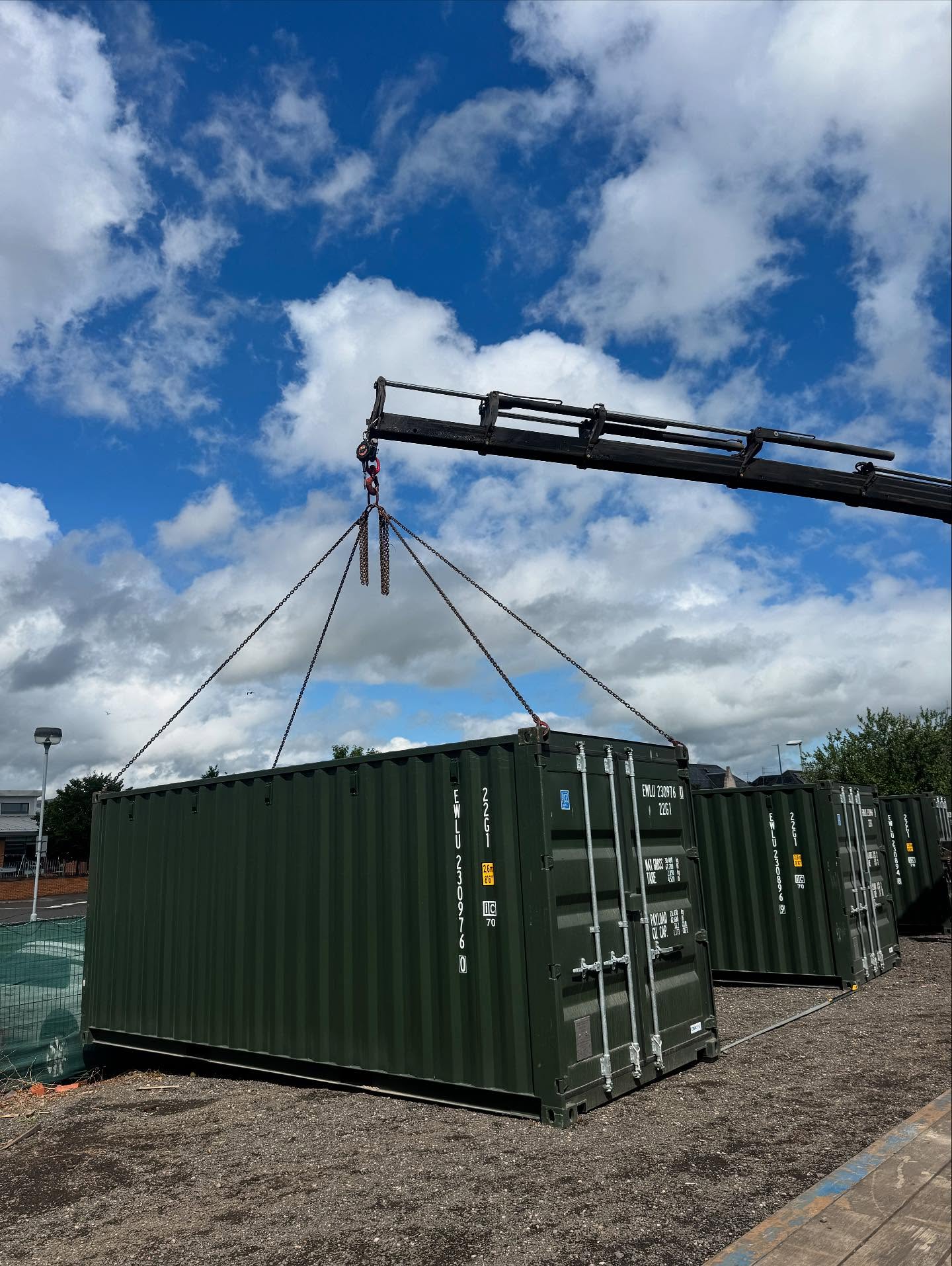
Can a Wagon-and-Drag HIAB Transport Containers?
Potentially, depending on the vehicle specification and the particular container.
Container transport involves more than simply having enough deck space.
The operator must consider:
- Container dimensions.
- Empty or loaded weight.
- Available lifting points.
- Crane capacity.
- Lifting radius.
- Vehicle payload.
- Axle loading.
- Load securing.
- Site access.
- Final placement position.
A container that can be transported legally may still be difficult to crane into position if the required placement point is too far away from the vehicle.
This is why container moves should be assessed around both transport and lifting requirements.
Wagon-and-Drag vs Standard Rigid HIAB
A standard rigid HIAB has one load platform and an onboard crane.
A wagon-and-drag adds a second load platform behind the rigid vehicle.
The advantage is increased carrying space and greater flexibility for mixed or multiple loads.
The disadvantage is that the complete vehicle becomes longer and requires more room to manoeuvre.
A standard rigid HIAB may therefore be more suitable for:
- Smaller sites.
- Shorter loads.
- Single-item moves.
- Tight residential access.
- Jobs where maximum carrying space is unnecessary.
A wagon-and-drag may be preferable where:
- Two load beds are useful.
- Multiple loads are being transported.
- Long materials are involved.
- Greater carrying capacity is needed.
- Different cargo needs separating.
- The trailer can be detached to improve site flexibility.
The choice should be based on the actual load and site rather than assuming the larger combination is automatically better.
Wagon-and-Drag vs Articulated HIAB
An articulated vehicle uses a tractor unit and semi-trailer.
A wagon-and-drag uses a rigid truck towing a separate drawbar trailer.
Both can provide substantial carrying capacity, but they behave differently on site.
The ability to disconnect the drag trailer while retaining a fully functional rigid HIAB can be a significant advantage for some jobs.
An articulated setup may be preferable for other types of long-distance or high-volume haulage.
The right option depends on:
- Cargo dimensions.
- Cargo weight.
- Required crane capacity.
- Site access.
- Journey distance.
- Unloading sequence.
- Trailer requirements.
- Number of loads.
There is no universal winner.
Does a Wagon-and-Drag Always Carry More?
Not necessarily.
It provides more load space, but physical deck area and legal payload are different things.
The crane, truck, trailer and equipment all contribute to the gross combination weight.
Heavy crane installations can significantly reduce the amount of payload available.
This means a vehicle with a larger deck does not necessarily have proportionally more carrying capacity.
The payload must be calculated from the specification of the actual combination and the proposed load distribution.
Weight Distribution Is Critical
Because the combination has multiple axles across two connected vehicles, where the load is placed matters.
Cargo cannot simply be put wherever there is free deck space.
The operator must consider both total weight and the load carried by individual axles.
A combination could potentially remain below its permitted overall gross weight while exceeding an axle limit because too much cargo has been concentrated in one area.
Heavy items therefore need to be positioned deliberately.
This is particularly important for:
- Precast concrete.
- Machinery.
- Steel bundles.
- Containers.
- Generators.
- Dense industrial equipment.
Load Order Matters Too
A wagon-and-drag may be carrying several items for one or more destinations.
The loading sequence should reflect the order in which those items will be required.
Placing the first delivery beneath or behind later cargo can create unnecessary handling.
Good load planning can reduce:
- Double handling.
- Crane movements.
- Waiting time.
- Trailer repositioning.
- Site disruption.
- Unnecessary unloading.
This is one of the less obvious benefits of having two separate load decks.
Different parts of the delivery can be organised around the order in which they will be needed.
Can the Trailer Be Used Without the Wagon?
The drag trailer cannot transport itself.
It must be towed by an appropriate vehicle.
However, once it has reached a suitable location, it may be uncoupled and left temporarily while the rigid wagon carries out other work.
This is different from saying that the trailer operates independently.
Its independence relates to loading and site organisation rather than road transport.
Site Access Still Needs Careful Planning
A wagon-and-drag offers flexibility, but it is still a large heavy-goods vehicle combination.
The approach route and working area need to accommodate its length, width, turning requirements and weight.
Before arranging a delivery, useful information includes:
- Gateway width.
- Road width.
- Turning space.
- Reversing area.
- Overhead restrictions.
- Ground conditions.
- Gradients.
- Weight restrictions.
- Space for stabilisers.
- Trailer parking space.
- Location of underground services.
Photographs and videos of complicated access routes can be extremely useful.
A wagon-and-drag should not be chosen simply because it can carry more if the combination cannot safely reach or work at the site.
This type of planning is particularly relevant for commercial and industrial projects in busy areas such as HIAB hire in Falkirk, where site access, industrial estates and onward Central Belt transport can all affect vehicle selection.
When Does a Wagon-and-Drag HIAB Make Sense?
A wagon-and-drag is most useful when the job genuinely benefits from the second load platform.
That could mean transporting more material in one journey, separating different cargo types or using the detachable trailer to improve how a large site is serviced.
It can be particularly suitable for:
- Large construction projects.
- Industrial relocations.
- Structural steel deliveries.
- Timber transport.
- Precast concrete.
- Multiple machinery movements.
- Mixed-load deliveries.
- Large commercial projects.
- Sites requiring staged unloading.
For smaller jobs, a standard rigid HIAB may be simpler and more economical.
For larger projects across the Central Belt, including HIAB hire in Edinburgh, wagon-and-drag combinations can be useful where additional carrying space and crane-assisted unloading are both required.
The Main Benefit of a Wagon-and-Drag HIAB
The defining advantage is flexibility.
A wagon-and-drag combines two separate load beds with an onboard hydraulic crane, giving the operator more options for transporting, organising and unloading substantial loads.
The trailer can provide additional carrying space when required and can potentially be uncoupled to allow the rigid HIAB to work independently on suitable sites.
That makes the configuration particularly useful for long materials, mixed construction loads, machinery and other jobs where both carrying capacity and crane-assisted handling are important.
However, the larger combination also requires more planning.
Payload, axle loading, crane reach, access, trailer positioning and unloading order all need to be considered before the job begins.
At HIAB Container Scotland, we can assess the load, collection point, delivery site and lifting requirements before determining the most suitable vehicle.
If you need steelwork, machinery, containers, construction materials or another heavy load transported and lifted, call 0800 755 5844 to discuss the job and request a quotation.